

Growth
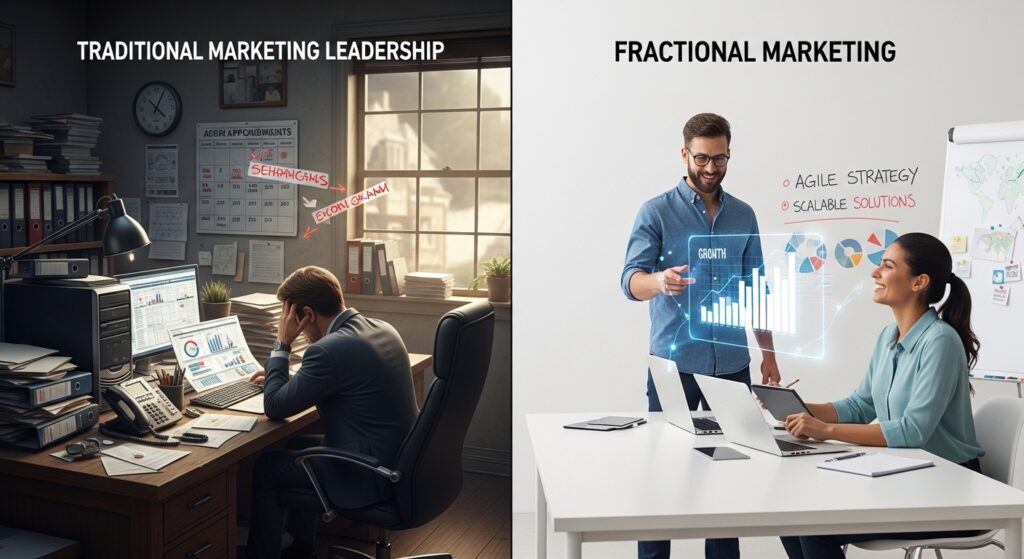
Why Fractional Marketing Is Replacing Traditional Marketing Leadership
Marketing leadership is undergoing a structural transformation. As growth cycles accelerate and competitive pressure intensifies, many companies are rethinking whether a traditional full-time executive model still delivers the best return.
Fractional marketing has emerged as a flexible, performance-driven alternative that provides strategic oversight without the long-term overhead of a permanent hire. For growth-focused companies, this shift is not about cutting costs. It is about improving efficiency, agility, and measurable impact.

Dallin Cottle
How Marketing Leadership Has Evolved Over the Past Decade
Over the last decade, the role of marketing leaders has evolved significantly. Marketing is no longer just about brand visibility. It is now directly tied to revenue, forecasting, customer acquisition, lifetime value, and pipeline growth. Executive teams expect leaders to drive strategy, analyze data, and align cross-functional teams effectively.
At the same time, the marketing landscape has become increasingly complex, with businesses managing paid media, organic search, content strategy, social platforms, automation, analytics, and constantly changing technology. This complexity puts pressure on traditional leadership structures, making it difficult for a single full-time executive to maintain both strategic clarity and operational agility.
Why The Full-Time Executive Model Is Losing Strategic Efficiency
Hiring a full-time Chief Marketing Officer once represented stability and long-term commitment. Today, it can represent risk.
Traditional executive hiring presents several structural challenges:
- Long recruitment cycles
- High salary and benefits costs
- Fixed overhead regardless of business performance
- Risk of cultural or strategic misalignment
- Limited flexibility during growth transitions
For early and mid-stage companies, committing to a permanent executive role can strain capital allocation. For larger companies, it can slow decision decision-making and reduce adaptability.
In a business environment defined by rapid change, fixed leadership structures often lack the responsiveness required to compete effectively.
The Rise of Flexible Leadership in Growth-Driven Companies
Modern companies are prioritizing flexibility over long-term commitment. The rise of fractional leadership across finance, operations, and marketing reflects a broader shift in how organizations structure executive talent.
Fractional marketing allows businesses to access senior-level strategy without committing to a full-time salary. This model provides executive insight, accountability, and revenue alignment while maintaining operational flexibility. ROAR Media provides comprehensive fractional marketing services that help companies implement strategies delivering measurable results while keeping teams agile.
Growth-driven companies are increasingly recognizing that leadership need not be permanent to be impactful. It needs to be aligned, measurable, and strategically focused.
How Fractional Marketing Aligns With Modern Business Agility
Agility has become a competitive advantage. Markets shift quickly. Consumer behavior evolves. Platforms change algorithms.
Fractional marketing supports agility in several ways:
- Strategic oversight without long-term lock-in
- Ability to scale involvement up or down based on growth stage
- Immediate executive-level insight without extended hiring timelines
- Focus on measurable outcomes tied to revenue performance
Rather than building heavy internal structures, companies can operate with lean teams guided by experienced strategic leadership.
This alignment between flexibility and expertise makes fractional marketing particularly effective for companies navigating growth, expansion, or repositioning.
Why Static Organisational Structures Slow Innovation
Innovation thrives in adaptable environments. When leadership structures are rigid, decision-making slows. Budget allocation becomes cautious. Strategic pivots require lengthy approvals.
Traditional marketing leadership models were designed for stability, not velocity.
In contrast, fractional marketing operates with performance clarity. Goals are defined. Metrics are visible. Strategy is evaluated against results rather than tenure.
This dynamic encourages faster experimentation, clearer accountability, and stronger alignment between marketing initiatives and business objectives.
The Long-Term Shift Toward Adaptive Marketing Leadership
Fractional marketing is not a temporary workaround. It reflects a larger evolution in executive design.
Businesses are moving toward adaptive leadership models that:
- Prioritize results over hierarchy
- Allocate capital strategically
- Reduce long-term risk
- Increase the speed of execution
- Align marketing directly with revenue growth
As companies continue to value flexibility, measurable impact, and financial efficiency, fractional marketing will likely become a standard leadership structure rather than an alternative option.
The shift is less about replacing titles than about replacing outdated frameworks with models that align with the realities of modern growth.
FAQs
Yes. It aligns strategy with revenue goals, reduces wasted spend, and improves visibility into performance.
Not necessarily. Many companies adopt it as a permanent, flexible leadership model.
Growth stage, founder-led, and mid-size companies seeking senior-level strategy without full-time overhead.
Yes. It often improves agency performance by providing strategic direction and accountability.
It can. Refining strategy and channel allocation helps improve efficiency and lower acquisition costs.
Many businesses see strategic clarity and improved alignment within the first few months.
Yes. It provides experienced leadership that adapts as the company scales.