
Why Hiring a Full-Time CMO Is Too Expensive for Startups

Growth Why Hiring a Full-Time CMO Is Too Expensive for Startups Startups often struggle to scale marketing because they need senior-level strategy but do not have the budget or stability to support a full-time executive. At an early-stage, revenue is unpredictable, and committing to a high-salary role can put unnecessary pressure on already limited resources. This is why many startups consider a fractional CMO as a more practical alternative. It provides access to experienced marketing leadership without the cost burden of a full-time hire, helping startups grow with more flexibility and control. Dallin Cottle What Does a Full-Time CMO Actually Cost a Startup? Hiring a full-time CMO is one of the most expensive leadership decisions a startup can make. Salary expectations A senior CMO typically commands a high annual salary, often ranging from six figures upward depending on experience and region. Hidden costs Beyond salary, startups also need to consider additional costs such as equity dilution, recruitment fees, onboarding and training, as well as employee benefits and bonuses. Long-term commitment A full-time hire is not flexible. Once onboarded, it becomes a fixed cost regardless of business performance or revenue fluctuations. Opportunity cost Investing heavily in one leadership role can limit the budget for other critical areas like product development, paid acquisition, or hiring specialists. Risk of a wrong hire If the CMO is not the right fit, replacing them is time-consuming and expensive, which can slow down growth and impact overall momentum. For many early-stage companies, this level of commitment is financially risky. Why Startups Struggle to Justify a Full-Time CMO Most startups operate in unpredictable environments where revenue, product direction, and customer acquisition channels are still evolving. In contrast, a full-time CMO typically expects stable budgets, clear growth systems, and a well-defined marketing infrastructure to deliver consistent results. This mismatch often leads to underutilization of senior talent, misaligned expectations, and a higher burn rate without proportional returns, making it a costly decision for early-stage startups. Challenges of Hiring a Full-Time COO in Startups Limited flexibility in early stages: Startups are still evolving, while a full-time COO role is more fixed. This makes it harder to adapt quickly as business needs change. Constantly shifting priorities: Product direction, market feedback, and funding situations keep changing. A fixed leadership role may struggle to keep up with these ongoing shifts. Slower decision-making: Adding a full-time leadership layer can slow down decisions. Startups often need to move fast, and delays can impact growth. Not always aligned with growth stage: Early-stage businesses are still experimenting and figuring things out. A full-time COO can feel too heavy for where the company currently stands. A Smarter Alternative to a Full-Time CMO A fractional CMO provides senior-level marketing leadership without the full-time cost commitment. Key benefits include: Strategic direction without long-term payroll burden Faster execution decisions based on experience Focused growth planning aligned with startup stages Access to expertise that would otherwise be unaffordable This model is especially useful for startups that need immediate clarity but are not ready for a full executive hire. Many businesses exploring fractional CMO services choose this approach to bridge the gap between execution and strategy. Fractional CMO vs Full-Time CMO: Cost and Value Comparison When comparing both models, the difference is not just cost but flexibility and risk. Full-Time CMO Fractional CMO High fixed salary Flexible monthly investment Long-term commitment Scales with business needs Best for mature, scaled companies Ideal for early and growth stage startups Higher financial risk for startups Lower financial risk with strategic impact For startups focused on efficiency and runway protection, the fractional model often delivers better return on investment. Final Thought Hiring senior marketing leadership is essential for growth, but timing and structure matter just as much as expertise. For most early-stage startups, flexibility, cost efficiency, and strategic clarity are more important than a full-time executive hire. Choosing the right model can make the difference between wasted spend and sustainable growth. At ROAR Media, we offer flexible marketing leadership and strategic guidance to help startups scale efficiently without the financial burden of a full-time CMO. FAQs Are fractional CMO services suitable for early-stage startups? Yes. Fractional CMO services are ideal for early-stage companies that need senior marketing expertise but cannot justify a full-time hire. How much does a full-time CMO cost compared to a fractional one? A full-time CMO requires a high fixed salary and long-term commitment, while a fractional CMO offers flexible monthly costs based on scope and engagement. What does a fractional CMO actually do for a startup? A fractional CMO provides strategic direction, builds marketing systems, guides execution, and helps align marketing efforts with business goals without being a full-time hire. When should a startup choose a fractional CMO over a full-time CMO? Startups should consider a fractional CMO when they need senior-level expertise but lack the budget, team structure, or stability to support a full-time executive role. Can a fractional CMO help improve marketing ROI? Yes. A fractional CMO focuses on strategy, efficiency, and data-driven decisions, helping startups reduce wasted spend and improve overall marketing performance.
Signs Your Salt Lake City Business Needs a Marketing Strategy Consultant

Growth Signs Your Salt Lake City Business Needs a Marketing Strategy Consultant Running a successful business in Salt Lake City requires more than hard work and dedication. Many business owners focus heavily on operations and product development, but without a clear marketing strategy, efforts can become scattered and ineffective. Hiring a marketing strategy consultant in Salt Lake City can help businesses identify growth opportunities, streamline campaigns, and achieve measurable results. A well-crafted strategy ensures that marketing efforts reach the right audience, increase engagement, and generate meaningful results. Dallin Cottle What Is a Marketing Strategy Consultant A marketing strategy consultant helps businesses define clear objectives, create actionable marketing plans, and implement strategies that align with overall business goals. They analyze current marketing campaigns, identify gaps, and provide guidance on where to invest resources for maximum impact. Consultants can advise on branding, messaging, audience targeting, and overall marketing operations, giving companies a roadmap for growth. Benefits for Salt Lake City Businesses Local businesses benefit from consulting in multiple ways. A fresh perspective allows owners to spot opportunities they may not see internally. Consultants help reduce trial-and-error marketing, saving time and money. Their expertise also helps businesses to improve customer acquisition, boost revenue, and make smarter decisions about scaling. Top Signs Your Salt Lake City Business Needs a Marketing Consultant Not every business realizes when it is time to bring in expert guidance, but certain signs indicate that your business could benefit from a marketing consultant. Marketing Efforts Not Working If your campaigns fail to generate leads or sales despite consistent effort, it may indicate a deeper strategic problem. A consultant can identify underperforming channels, optimize ad spend, and recommend changes that improve results. Many businesses see immediate improvements simply by adjusting messaging, targeting, or marketing mix. No Clear Audience Strategy Reaching the right audience is critical for success. Without a clearly defined target audience, even the best marketing materials may fall flat. Consultants help businesses understand who their customers are, how to reach them, and what messages resonate best. This clarity allows for higher engagement, better conversion rates, and stronger brand loyalty. Team Lacks Expertise Small marketing teams or teams stretched across multiple roles often lack specialized expertise in digital strategy, analytics, or creative content. A consultant fills these gaps by offering expert guidance, ensuring campaigns are strategically sound and executed efficiently. This collaboration also upskills your team, leaving them better equipped for future initiatives. Expanding or Launching a Product Growth often brings challenges. Entering new markets or launching a new product requires careful planning and execution. A marketing consultant can create a targeted go-to-market strategy, recommend the best channels, and provide data-driven guidance to reduce risk and maximize impact. Need Growth Without a Full-Time Executive Hiring a full-time CMO or marketing director may not be feasible for every business, especially startups or small companies. Working with a marketing strategy consulting firm in Salt Lake City allows companies to access executive-level expertise on a flexible basis. This approach provides strategic leadership without the cost of a permanent hire. How a Marketing Consultant Can Help Your Salt Lake City Business A marketing consultant provides the expertise and guidance your business needs to improve strategy, execution, and results. Audit Your Current Marketing Strategy Consultants thoroughly review your existing marketing initiatives, including campaigns, social media, content, and paid advertising. This audit identifies what is working, what is not, and where improvements can be made. By understanding the full picture, businesses can reallocate resources efficiently and eliminate wasted effort. Actionable Data-Driven Recommendations Consultants translate insights from the audit into practical steps. Recommendations may include refining messaging, adjusting target audiences, testing new channels, or improving conversion tracking. Businesses benefit from clear, actionable guidance that can be implemented immediately to drive results. Optimize Campaigns for Maximum ROI A marketing consultant continuously monitors performance and adjusts strategies as needed. This ensures that campaigns remain effective and the budget is spent wisely. Optimization includes analyzing metrics, split-testing creative, and refining targeting to ensure maximum return on investment. How to Maximize the Impact of a Marketing Consultant To get the most from a marketing consultant, focus on goals, collaboration, and continuous improvement. Align Goals with Business Objectives: Defining clear goals ensures the consultant focuses on strategies that directly drive growth and measurable results. Collaborate on Strategy and Execution: By working together, your team can apply strategies effectively and learn key marketing insights. Track Results and Optimize: Monitoring performance and refining campaigns keeps marketing efforts efficient and aligned with objectives. Grow Smarter with Professional Support If your Salt Lake City business shows any of these signs, it is time to consider hiring a marketing strategy consultant. Partnering with an experienced marketing strategy consulting firm can help businesses save time, reduce errors, and grow efficiently. ROAR Media offers personalized marketing consultation services to help local companies achieve measurable results and make informed decisions about growth. FAQs How do I know if my business needs a marketing consultant in Salt Lake City? Signs include poor marketing results, lack of direction, limited expertise, or plans to expand into new markets. Can a marketing strategy consulting firm in Salt Lake City help small businesses? Yes, consultants design cost-effective strategies that maximize growth potential while staying within small business budgets. How long does it take to see results from hiring a marketing strategy consultant? Results vary, but actionable recommendations from consultants can often generate measurable improvements within weeks or months. What should I expect during a marketing consultation session? Expect a thorough review of current marketing, identification of gaps, and clear recommendations to improve performance and ROI. How much does it cost to hire a marketing strategy consultant in Salt Lake City? Costs vary depending on scope, but consultants provide flexible, value-driven services that fit businesses of different sizes and budgets.
10 Signs Your Business Needs a Fractional Chief Marketing Officer

Growth 10 Signs Your Business Needs a Fractional Chief Marketing Officer Marketing often starts simply. In the early stages of a business, founders handle messaging, campaigns, and growth initiatives themselves. As the company grows, however, marketing becomes more complex and harder to manage without experienced leadership. Dallin Cottle Many businesses reach a stage where marketing activity increases, but results remain inconsistent. Campaigns run, budgets grow, and teams stay busy, yet growth still feels unpredictable. This is often the point where a fractional chief marketing officer becomes valuable. Instead of hiring a full-time executive, companies gain senior-level marketing leadership on a flexible basis. The right fractional CMO brings strategic clarity, aligns marketing with business goals, and helps teams execute more effectively. Recognizing when your business needs this level of leadership can make the difference between scattered marketing efforts and sustainable growth. Why Businesses Reach a Marketing Leadership Gap As companies expand, marketing naturally evolves from simple tactics into a broader growth function. New channels appear, customer expectations shift, and internal teams grow. Without experienced leadership, marketing can quickly become fragmented. Different teams may focus on different priorities, and strategies often develop without a clear connection to revenue goals. A fractional CMO helps bridge this leadership gap. By introducing structure, prioritization, and accountability, businesses gain a strategic direction that aligns marketing with long-term growth. Signs Your Business Needs a Fractional CMO Efficiency is critical to scaling marketing operations. A fractional CMO establishes repeatable systems that include: Streamlined workflows that reduce friction in campaign execution Standardized processes for approvals, messaging, and cross-channel alignment Systems that maintain quality and consistency even as marketing activity increases The ability to expand marketing efforts without adding unnecessary overhead Optimizing Team Structure and Collaboration Your Marketing Lacks a Clear Strategy Many companies run multiple campaigns across various platforms, but still struggle to explain their overall marketing strategy. Without a clear strategy, marketing becomes reactive. Teams chase new trends, experiment with channels, and make decisions based on short-term results rather than long-term growth. A fractional chief marketing officer establishes a clear roadmap that connects marketing activities with measurable business objectives. Marketing and Sales aren’t Aligned When marketing and sales operate separately, growth slows. Marketing teams may focus on generating leads while sales teams struggle with lead quality or inconsistent messaging. A fractional CMO aligns both functions by defining shared goals, improving communication, and ensuring that marketing efforts support the sales pipeline effectively. Your Team is Busy, but Results are Inconsistent Activity doesn’t always translate into growth. Many businesses produce content, run ads, and manage multiple channels without seeing predictable outcomes. This often indicates a lack of prioritization. A fractional CMO evaluates what actually drives results and refocuses resources on the most impactful initiatives. Marketing Decisions are Based on Guesswork Without experienced leadership, marketing decisions often rely on assumptions rather than data. Businesses experiment constantly but struggle to determine what works. A fractional CMO introduces a data-driven approach, helping companies track performance metrics, evaluate campaigns, and make informed decisions based on measurable outcomes. Your Business is Scaling, but Marketing Hasn’t Evolved Growth brings new challenges. As businesses scale, marketing must support larger audiences, more complex products, and stronger competition. If marketing strategies remain unchanged while the business grows, the gap becomes increasingly visible. A fractional CMO ensures that marketing evolves alongside the company. You Can’t Justify Hiring a Full-Time CMO Yet Hiring a full-time chief marketing officer is a major investment. For many growing companies, the cost may not yet be justified. A fractional CMO offers the same strategic expertise on a part-time basis. Businesses receive executive-level leadership without committing to a full-time salary. Marketing Budgets are Increasing Without Clear ROI As marketing budgets grow, leadership expects clearer returns. Without a strategic framework, spending can rise while results remain unclear. A fractional chief marketing officer introduces performance tracking, ensuring that investments in advertising, content, and campaigns deliver measurable value. Your Marketing Team Lacks Senior Leadership Internal marketing teams often consist of specialists focused on execution. They may excel in areas such as SEO, paid advertising, or content creation, but still need strategic direction. A fractional CMO provides leadership that helps specialists work toward a shared objective, improving coordination and overall performance. Your Business is Entering a New Growth Stage Major transitions such as entering new markets, launching new products, or preparing for investment require stronger marketing leadership. A fractional chief marketing officer helps guide these transitions by defining positioning, refining messaging, and building scalable marketing strategies. Marketing Feels Disconnected From Business Goals One of the clearest signs is when marketing operates independently from overall business objectives. Campaigns may perform well individually but fail to contribute meaningfully to revenue growth. A fractional CMO connects marketing strategy directly to business priorities, ensuring that every initiative supports broader company goals. How a Fractional CMO Transforms Marketing Leadership The introduction of experienced marketing leadership often changes how a company approaches growth. Instead of scattered tactics, businesses operate with a clear strategic direction. The difference can be seen across several areas. Area Before Fractional CMO After Fractional CMO Strategy Channel-focused Business-focused Goals Unclear priorities Measurable objectives Budget Reactive spending Strategic investment Team alignment Disconnected efforts Coordinated execution Performance Inconsistent results Predictable growth This shift allows businesses to move from experimentation toward scalable marketing systems. When Businesses Typically Hire a Fractional CMO Companies often engage a fractional chief marketing officer during key growth stages. These moments typically include periods when marketing complexity increases, but internal leadership hasn’t yet expanded. Common situations include: Early growth after product-market fit Expansion into new markets Rapid scaling with limited internal structure Marketing teams needing executive direction Preparing for funding or acquisitions In each case, fractional leadership provides the strategic oversight needed to guide marketing decisions with greater confidence. Why Fractional CMO Leadership Supports Sustainable Growth Businesses rarely struggle because of a lack of marketing activity. The challenge usually lies in a lack of direction. A fractional CMO introduces the strategic thinking required to connect marketing initiatives with long-term
How a Fractional CMO Builds a Scalable Marketing Infrastructure

Growth How a Fractional CMO Builds a Scalable Marketing Infrastructure Modern businesses require marketing systems that can adapt, scale, and consistently deliver results as the company evolves. A fractional CMO provides strategic guidance to design scalable infrastructure, implement repeatable processes, and align teams for maximum efficiency. This blog explores how fractional chief marketing officers create marketing systems that are structured, measurable, and built for long-term success. Dallin Cottle What Makes Marketing Infrastructure Scalable Scalable marketing infrastructure is more than just campaigns and tactics. It is a framework that allows your marketing efforts to expand without losing efficiency or quality. Core components of a scalable marketing system include: Repeatable processes that ensure consistency across campaigns Clearly defined team roles and responsibilities Measurable outcomes to track performance and impact Operational consistency that allows the system to expand efficiently When infrastructure is designed for scalability, marketing teams can execute campaigns more quickly, track results more effectively, and adapt strategies as the business evolves. The Fractional CMO’s Strategic Role A fractional CMO brings executive-level strategy without the full-time cost. They translate business objectives into actionable marketing plans that internal teams can execute efficiently. This involves prioritizing initiatives by impact, identifying operational bottlenecks, and designing processes to ensure campaigns are consistent across channels. By providing senior guidance, a fractional CMO aligns marketing activity with revenue objectives and business goals, creating a clear roadmap for repeatable success. Creating Repeatable Systems for Efficiency Efficiency is critical to scaling marketing operations. A fractional CMO establishes repeatable systems that include: Streamlined workflows that reduce friction in campaign execution Standardized processes for approvals, messaging, and cross-channel alignment Systems that maintain quality and consistency even as marketing activity increases The ability to expand marketing efforts without adding unnecessary overhead Optimizing Team Structure and Collaboration A scalable marketing system requires the right team structure. Fractional CMOs define clear roles and responsibilities to avoid overlap and confusion. They mentor teams to operate independently while maintaining alignment with overall strategy. By identifying skill gaps and reallocating resources efficiently, fractional CMOs reduce bottlenecks and improve accountability. Teams become empowered to execute campaigns reliably, and leadership gains clear visibility into performance and results. Tracking Performance and Operational Effectiveness Measurement is a key part of scalable marketing. A fractional CMO focuses on: Establishing key performance indicators to track infrastructure effectiveness and campaign success Monitoring outcomes across all marketing channels Analyzing efficiency to identify strengths and weaknesses Using data to refine and improve processes Continuously identifying areas for improvement and allocating resources strategically How a Fractional CMO Streamlined Marketing for Reliable Results Consider a mid-size company struggling with fragmented campaigns and unclear team responsibilities. A fractional CMO assesses existing processes, implements repeatable workflows, and aligns the team around a unified marketing framework. Within months, campaigns are executed more efficiently, performance becomes measurable across all channels, and operational effectiveness improves. The company achieves better results without hiring additional full-time leadership, demonstrating how a fractional CMO builds infrastructure that scales reliably. Implementing Scalable Marketing Infrastructure To implement scalable marketing systems, begin by evaluating existing marketing processes and team structures. A Fractional CMO provides guidance on aligning strategy with operations, designing repeatable workflows, and mentoring teams for effective execution. Companies looking to optimize marketing infrastructure can leverage ROAR Media’s Fractional CMO services for executive leadership, measurable results, and systems built to support long-term operational efficiency. Conclusion Building a scalable marketing infrastructure is no longer optional for companies looking to operate efficiently and achieve measurable results. By leveraging fractional CMO expertise, businesses can implement systems that adapt to evolving needs, optimize performance, and deliver lasting impact. Partnering with ROAR Media gives companies access to this leadership, helping transform marketing operations into a structured, results-driven engine for long-term success. FAQs What types of companies benefit most from a fractional CMO? Startups, mid-size businesses, and rapidly scaling companies gain strategic marketing leadership without long-term full-time costs. How quickly can a fractional CMO deliver results? Many organizations see improvements in strategy, workflows, and measurable insights within the first few weeks. How does a fractional CMO improve team collaboration? By defining roles, setting expectations, and mentoring teams, bottlenecks are reduced and accountability increases. What responsibilities does a fractional CMO cover? They handle strategy, process design, team mentoring, performance tracking, and aligning marketing with business goals. Are fractional CMO services suitable for scaling campaigns? Yes, they design systems that allow campaigns to expand without compromising quality or execution consistency.
Why Fractional Marketing Is Replacing Traditional Marketing Leadership

Growth Why Fractional Marketing Is Replacing Traditional Marketing Leadership Marketing leadership is undergoing a structural transformation. As growth cycles accelerate and competitive pressure intensifies, many companies are rethinking whether a traditional full-time executive model still delivers the best return. Fractional marketing has emerged as a flexible, performance-driven alternative that provides strategic oversight without the long-term overhead of a permanent hire. For growth-focused companies, this shift is not about cutting costs. It is about improving efficiency, agility, and measurable impact. Dallin Cottle How Marketing Leadership Has Evolved Over the Past Decade Over the last decade, the role of marketing leaders has evolved significantly. Marketing is no longer just about brand visibility. It is now directly tied to revenue, forecasting, customer acquisition, lifetime value, and pipeline growth. Executive teams expect leaders to drive strategy, analyze data, and align cross-functional teams effectively. At the same time, the marketing landscape has become increasingly complex, with businesses managing paid media, organic search, content strategy, social platforms, automation, analytics, and constantly changing technology. This complexity puts pressure on traditional leadership structures, making it difficult for a single full-time executive to maintain both strategic clarity and operational agility. Why The Full-Time Executive Model Is Losing Strategic Efficiency Hiring a full-time Chief Marketing Officer once represented stability and long-term commitment. Today, it can represent risk. Traditional executive hiring presents several structural challenges: Long recruitment cycles High salary and benefits costs Fixed overhead regardless of business performance Risk of cultural or strategic misalignment Limited flexibility during growth transitions For early and mid-stage companies, committing to a permanent executive role can strain capital allocation. For larger companies, it can slow decision decision-making and reduce adaptability. In a business environment defined by rapid change, fixed leadership structures often lack the responsiveness required to compete effectively. The Rise of Flexible Leadership in Growth-Driven Companies Modern companies are prioritizing flexibility over long-term commitment. The rise of fractional leadership across finance, operations, and marketing reflects a broader shift in how organizations structure executive talent. Fractional marketing allows businesses to access senior-level strategy without committing to a full-time salary. This model provides executive insight, accountability, and revenue alignment while maintaining operational flexibility. ROAR Media provides comprehensive fractional marketing services that help companies implement strategies delivering measurable results while keeping teams agile. Growth-driven companies are increasingly recognizing that leadership need not be permanent to be impactful. It needs to be aligned, measurable, and strategically focused. How Fractional Marketing Aligns With Modern Business Agility Agility has become a competitive advantage. Markets shift quickly. Consumer behavior evolves. Platforms change algorithms. Fractional marketing supports agility in several ways: Strategic oversight without long-term lock-in Ability to scale involvement up or down based on growth stage Immediate executive-level insight without extended hiring timelines Focus on measurable outcomes tied to revenue performance Rather than building heavy internal structures, companies can operate with lean teams guided by experienced strategic leadership. This alignment between flexibility and expertise makes fractional marketing particularly effective for companies navigating growth, expansion, or repositioning. Why Static Organisational Structures Slow Innovation Innovation thrives in adaptable environments. When leadership structures are rigid, decision-making slows. Budget allocation becomes cautious. Strategic pivots require lengthy approvals. Traditional marketing leadership models were designed for stability, not velocity. In contrast, fractional marketing operates with performance clarity. Goals are defined. Metrics are visible. Strategy is evaluated against results rather than tenure. This dynamic encourages faster experimentation, clearer accountability, and stronger alignment between marketing initiatives and business objectives. The Long-Term Shift Toward Adaptive Marketing Leadership Fractional marketing is not a temporary workaround. It reflects a larger evolution in executive design. Businesses are moving toward adaptive leadership models that: Prioritize results over hierarchy Allocate capital strategically Reduce long-term risk Increase the speed of execution Align marketing directly with revenue growth As companies continue to value flexibility, measurable impact, and financial efficiency, fractional marketing will likely become a standard leadership structure rather than an alternative option. The shift is less about replacing titles than about replacing outdated frameworks with models that align with the realities of modern growth. FAQs Can fractional marketing improve return on investment? Yes. It aligns strategy with revenue goals, reduces wasted spend, and improves visibility into performance. Is fractional marketing a temporary solution? Not necessarily. Many companies adopt it as a permanent, flexible leadership model. What types of businesses benefit most from fractional marketing? Growth stage, founder-led, and mid-size companies seeking senior-level strategy without full-time overhead. Can fractional marketing work alongside agencies? Yes. It often improves agency performance by providing strategic direction and accountability. Does fractional marketing help reduce customer acquisition costs? It can. Refining strategy and channel allocation helps improve efficiency and lower acquisition costs. How quickly can fractional marketing deliver impact? Many businesses see strategic clarity and improved alignment within the first few months. Is fractional marketing suitable during rapid expansion? Yes. It provides experienced leadership that adapts as the company scales.
How a Marketing Strategy Consultant Can Identify Gaps in Your Marketing Plan

Growth How a Marketing Strategy Consultant Can Identify Gaps in Your Marketing Plan Running marketing without a clear strategy can feel like navigating a maze blindfolded. Even businesses with dedicated marketing teams often overlook critical gaps that limit growth, waste budget, and reduce results. A marketing strategy consultant brings an expert outside perspective to identify these gaps and provide actionable solutions that align with your business goals. Dallin Cottle Signs Your Marketing Plan Needs a Professional Review Before engaging a consultant, it helps to recognize warning signs that your plan may have gaps. These include: Spending on marketing with little measurable return Inconsistent brand messaging across channels Poor audience engagement or low conversion rates Disconnected or overlapping marketing campaigns Lack of clarity on marketing goals or priorities Recognizing these signals shows that a professional review could uncover opportunities to strengthen your strategy. What Is a Marketing Strategy Consultant and Why Hire One A marketing strategy consultant is an expert who evaluates your marketing plan, identifies weaknesses, and provides actionable recommendations. Unlike in-house marketers, consultants offer: Objectivity – spotting issues internal teams may miss Expertise – bringing industry knowledge and proven methods Strategic focus – prioritizing initiatives with the highest impact By working with a consultant, businesses gain clarity on what works, what does not, and how to improve results sustainably. How Consultants Identify Gaps Step by Step Marketing strategy consultants use a structured approach to uncover gaps: Audit current campaigns and channels to assess effectiveness Map the customer journey to find drop-off points and conversion barriers Benchmark against competitors to identify opportunities and weaknesses Analyze performance metrics and key indicators to determine areas needing attention Prioritize gaps based on potential business impact This process ensures the insights are actionable and tailored to your business. Common Marketing Gaps Consultants Detect Consultants typically identify gaps in the following areas: Audience targeting and segmentation – ensuring the right message reaches the right people Messaging and brand positioning – creating clear and consistent communicationChannel strategy and campaign execution – focusing on platforms that deliver the best results Budget allocation – maximizing marketing spend efficiency Content and search engine optimization strategy – producing effective content aligned with business goals Addressing these gaps helps optimize marketing efforts and improve return on investment. Tools and Frameworks Used for Gap Analysis Consultants rely on tools and frameworks to evaluate marketing plans, including: Type Item Purpose Framework SWOT Analysis Examine strengths, weaknesses, opportunities, and threats of your marketing strategy Framework Marketing Audits Review campaigns, content, and lead generation processes Framework Funnel Assessments Analyze customer journey and conversion pathways Tool Analytics Dashboards Track audience behavior, engagement, and campaign performance Tool Customer Relationship Management Systems Monitor customer interactions, leads, and conversions These tools and frameworks provide both a broad overview and detailed insights into your marketing strategy. Turning Gap Analysis into Actionable Strategies Identifying gaps is only valuable when followed by action. Consultants help translate insights into steps such as: Optimizing campaigns to increase effectiveness Reallocating budget to focus on high-performing channels Refining messaging to maintain consistency and impact Setting measurable goals and tracking progress over time This ensures your marketing plan is strategic, focused, and growth-oriented. When to Bring in a Marketing Strategy Consultant Engage a consultant when your business experiences: Unclear direction in marketing campaigns Marketing efforts are underperforming despite investment Difficulty reaching or engaging your target audience Need to scale or pivot marketing strategy without internal expertise Consultants bridge the gap between strategy and execution, helping your marketing align with overall business objectives. Next Steps From Gap Analysis to Business Growth A marketing consultation is often the first step toward creating a comprehensive marketing strategy or working with a fractional chief marketing officer. By identifying gaps and prioritizing improvements, ROAR Media helps your business focus on what works, optimize resources, and achieve measurable growth. FAQs How long does a typical marketing consultation take? A marketing consultation usually lasts 1 to 3 hours, depending on the size of your business and the complexity of your marketing plan. Some consultations may include follow-up sessions to review recommendations and track progress. Can a marketing consultant work with small businesses on a limited budget? Yes, many marketing consultants offer flexible packages tailored for small businesses. They can focus on the areas with the highest impact, helping you get actionable insights without exceeding your budget. Do marketing consultants implement the strategies they recommend? Some consultants provide full implementation support, while others focus solely on analysis and strategy recommendations. It is important to clarify this with your consultant before starting. How often should a business have a marketing consultation? Businesses typically benefit from a marketing consultation once or twice a year, or whenever launching a new product, entering a new market, or experiencing stagnant growth. Regular consultations ensure strategies remain aligned with changing business goals. Are marketing consultations suitable for e-commerce and service-based businesses alike? Absolutely. Marketing consultations are valuable for all business types because they identify gaps in audience targeting, conversion paths, and messaging, regardless of the industry or business model. How do consultants measure the success of their recommendations? Consultants often track key performance indicators that matter most to your business, such as lead generation, customer acquisition costs, website traffic growth, or conversion rates. Success is measured by the improvements in these metrics after implementing recommendations. Can a marketing consultation help with branding and positioning? Yes. Consultants often provide insights on refining your brand messaging, defining your value proposition, and ensuring consistent positioning across all channels to resonate with your target audience.
How Fractional CMO Services Fix Lead Quality Issues in Real Estate

Growth How Fractional CMO Services Fix Lead Quality Issues in Real Estate Lead quality is one of the biggest challenges in real estate marketing today. Many businesses generate steady enquiries, but too few of those leads are ready, relevant, or likely to convert. Activity increases, yet results fall short. Fractional CMO services address this by bringing structure and clarity to lead generation and qualification. The focus shifts from volume to intent. This guide explains how fractional CMO services fix lead quality issues in real estate and why this approach matters in 2026. Dallin Cottle Why Lead Quality Becomes a Problem in Real Estate Marketing Lead quality issues usually develop gradually. As real estate businesses grow, marketing efforts often expand faster than strategy. Common outcomes include: High enquiry volume with low conversion rates Leads that are unqualified, unresponsive, or misaligned Sales teams spending time filtering rather than selling Marketing reports showing activity but limited impact In many cases, marketing is optimised for volume rather than intent. Without senior oversight, campaigns are judged by cost per lead instead of lead relevance. This is where lead quality begins to erode. What Lead Quality Actually Means in Real Estate Lead quality is not a single metric. In real estate, high-quality leads typically demonstrate: Clear buying or selling intent Alignment with target locations or property types Readiness within a realistic time frame Behaviour that signals seriousness rather than curiosity Fractional CMO services focus on defining these signals clearly before optimising marketing activity around them. The Role of a Fractional CMO in Fixing Lead Quality A fractional CMO steps into the business as senior marketing leadership. Rather than managing individual campaigns, they take ownership of how leads are generated, evaluated, and acted upon. This includes: Aligning marketing goals with sales reality Defining what a qualified lead looks like Ensuring campaigns are built around intent rather than volume Creating accountability across teams and vendors This leadership layer is critical for improving lead quality without increasing waste. How Fractional CMO Services Diagnose Lead Quality Issues Lead quality problems cannot be solved without understanding their source. A fractional CMO begins by evaluating: Where leads are coming from How leads are being tracked and categorised Which channels produce conversions rather than enquiries How follow-up processes impact outcomes This diagnosis often reveals that the issue is not traffic or spend, but misalignment between marketing signals and business objectives. Fixing Lead Quality at the Strategy Level Fractional CMO services address lead quality before execution begins. This includes: Refining target buyer and seller profiles Clarifying geographic and property focus Adjusting messaging to filter intent earlier Aligning offers with readiness rather than curiosity When strategy is clear, campaigns naturally attract fewer low-intent enquiries. Improving Lead Quality Through Channel Prioritization Not all channels deliver the same type of lead. Fractional CMOs evaluate channels based on intent signals rather than solely on cost efficiency. This often leads to: Reducing reliance on channels that inflate volume without conversion Increasing investment in sources that attract decision-ready prospects Aligning channel mix with different stages of the buyer or seller journey Lead quality improves when channels are chosen for relevance rather than reach. How Messaging and Creative Influence Lead Quality Lead quality is strongly influenced by what is said and how it is framed. Fractional CMO services ensure that messaging: Sets clear expectations Speaks directly to motivated buyers and sellers Discourages low-commitment enquiries Reflects the realities of the market Clear messaging acts as a filter. It attracts serious prospects while naturally excluding those who are not ready. Aligning Marketing and Sales Around Lead Quality Even strong leads lose value without proper alignment. A fractional CMO connects marketing and sales by: Defining shared qualification criteria Improving lead handoff processes Adjusting campaigns based on sales feedback Establishing consistent performance reviews This feedback loop ensures lead quality improves over time rather than stagnating. Measuring Lead Quality the Right Way Lead quality cannot be improved if it is not measured correctly. Fractional CMO services focus on indicators such as: Conversion to an appointment or valuation Speed and effectiveness of follow-up Close rates by channel Revenue contribution rather than lead count This shifts reporting away from surface metrics and toward business outcomes. Why Fractional CMO Services Are Effective in Real Estate Real estate marketing sits at the intersection of timing, trust, and intent. Fractional CMOs bring experience navigating this complexity across different market conditions. Teams such as ROAR Media operate in this role by focusing on structure, decision-making, and accountability rather than on tactical execution alone. This approach allows lead quality to improve without increasing internal overhead or complexity. Who Benefits Most From Fractional CMO Services Fractional CMO services are especially effective for real estate businesses that: Generate leads but struggle with conversion Work with multiple vendors and platforms Lacks a clear definition of lead quality Want predictable growth rather than sporadic wins They are particularly valuable for founder-led brokerages, teams, and investment firms entering a more mature growth phase. How Fixing Lead Quality Supports Sustainable Growth High-quality leads reduce friction across the business. When lead quality improves: Sales teams focus on closing rather than filtering Marketing spend becomes more efficient Forecasting becomes more reliable Operational stress decreases Growth becomes steadier and more predictable. Final Takeaway Lead quality issues in real estate are rarely solved by generating more enquiries. They are solved by clarity, alignment, and leadership. Fractional CMO services improve lead quality by aligning strategy, messaging, channels, and measurement into a unified system. For real estate businesses navigating competitive and complex markets in 2026, this approach provides a practical path to better outcomes without unnecessary scale. FAQs Will a fractional CMO replace my agency or marketing team? No. They provide leadership and direction while existing teams handle execution. Is this suitable for small or founder-led real estate teams? Yes. It’s often most effective before scaling spend or adding new channels. Can fractional CMO services work in changing market conditions? Yes. Strategy and messaging are adjusted regularly based on performance and market shifts. What
What Fractional Marketing Looks Like for Growth-Focused Companies in Salt Lake City

Growth What Fractional Marketing Looks Like for Growth-Focused Companies in Salt Lake City If you are searching for fractional marketing in Salt Lake City, you are likely a founder, CEO, or leadership team member who needs senior-level marketing direction without the cost or commitment of building a full internal team. This guide explains what fractional marketing actually looks like for growth-focused companies in Salt Lake City, how it works in practice, and when it makes sense to use it as a growth lever. Dallin Cottle What Is Fractional Marketing? Fractional marketing gives growing companies access to senior marketing leadership on a part-time or embedded basis. Instead of hiring a full-time executive or managing multiple disconnected vendors, businesses get a clear strategy, execution oversight, and accountability tied directly to revenue and growth goals. In Salt Lake City, this model is commonly used by companies that want to scale efficiently without overbuilding their internal team. What Does Fractional Marketing Mean in Practice? Fractional marketing is not task-based support and not short-term consulting. It is an ongoing leadership role where an experienced marketer steps into the business and takes ownership of marketing direction, priorities, and performance. This includes: Setting strategy Making informed decisions Aligning teams and vendors Owning outcomes, not just recommendations For Salt Lake City companies, fractional marketing often looks like a flexible executive presence that adapts to growth stage, internal capacity, and market conditions. Why Are Salt Lake City Companies Choosing Fractional Marketing? Salt Lake City has become a strong hub for SaaS, professional services, real estate, and fast-scaling local brands. Many of these companies face similar challenges as they grow. Common reasons fractional marketing becomes attractive include: Growth outpacing internal marketing structure Founders still making most marketing decisions Multiple vendors involved, but no single owner of the results Hiring a full-time executive feels premature or risky Fractional marketing fills this gap by adding leadership before marketing complexity turns into chaos. What Does a Fractional Marketing Leader Actually Do? A fractional marketing leader operates inside the business, not on the sidelines. Typical responsibilities include: Setting a clear marketing strategy tied to revenue goals Prioritizing channels, campaigns, and spend Aligning internal staff and external vendors Establishing KPIs and performance benchmarks Reviewing data and adjusting direction based on results The goal is to create clarity, focus, and momentum where marketing previously felt scattered or reactive. How Is Fractional Marketing Different From Other Options? Marketing Option Level of Ownership Cost Structure Best For Full-Time Marketing Executive High High fixed salary Large, mature teams Marketing Agency Medium Monthly retainer Execution support Marketing Consultant Low Project or hourly Advice and audits Fractional Marketing High Part-time investment Growing companies Fractional marketing combines the ownership of a full-time executive with the flexibility of an agency, without long-term overhead. How Does Fractional Marketing Work Step by Step? Discovery and AlignmentBusiness goals, revenue targets, and constraints are defined. Audit and Gap IdentificationExisting marketing efforts, channels, and data are reviewed. Strategy and Roadmap CreationA clear plan is built around priorities and timelines. Execution OversightInternal teams and vendors are directed toward measurable outcomes. Measurement and OptimizationPerformance is tracked, and strategy is refined continuously. This process keeps marketing focused, accountable, and tied to business results. Who Is Fractional Marketing Best For in Salt Lake City? Fractional marketing is a strong fit for companies that: Are growing but lack senior marketing leadership Have revenue goals but inconsistent lead flow Manage multiple vendors without a unified strategy Want executive-level thinking without full-time cost It is especially effective for founder-led businesses transitioning into their next growth phase. How Does Fractional Marketing Support Sustainable Growth? Rather than chasing trends or isolated tactics, fractional marketing focuses on building systems. These systems support: Predictable lead generation Strong positioning in competitive markets Smarter allocation of marketing budget Clear accountability across teams This approach creates stability and scalability over time. Why Experience and Local Context Matter Marketing decisions are never made in a vacuum. Local market behavior, customer expectations, and competitive dynamics all influence what works. Working with a team like ROAR Media means fractional marketing leadership that understands growth-stage businesses and how to turn strategy into execution within the Salt Lake City market. Final Takeaway Fractional marketing in Salt Lake City is not about doing more marketing. It is about doing the right marketing with clear leadership and accountability. For growth-focused companies, it offers a practical way to scale without unnecessary risk or overhead. FAQs What is fractional marketing? Fractional marketing provides senior-level marketing leadership on a part-time basis without hiring a full-time executive. How much time does a fractional marketer typically spend? Engagements vary, but most companies start with a few focused days per month and adjust as needed. Is fractional marketing only for startups? No. Many established companies use fractional marketing to scale efficiently or restructure their marketing function. Does fractional marketing replace agencies or vendors? Not usually. It provides leadership and direction while agencies handle execution. How are results measured? Success is tracked through KPIs tied to leads, conversions, revenue growth, and operational efficiency.
Fractional CMO Services vs Fractional Marketing Consultants: What’s the Difference?
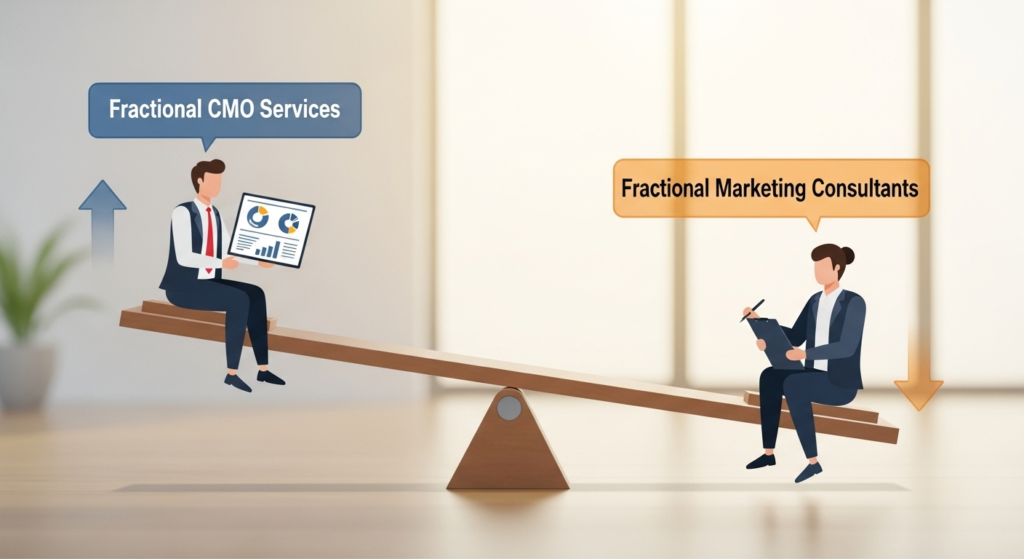
Growth Fractional CMO Services vs Fractional Marketing Consultants: What’s the Difference? As more businesses look for flexible marketing leadership, two options come up again and again:fractional CMO services and fractional marketing consultants. Dallin Cottle On the surface, they can sound similar.Both are part-time.Both bring experience.Both promise clarity. But in practice, they serve very different roles inside a business. Understanding that difference matters because hiring the wrong one can slow growth rather than accelerate it. Why This Distinction Matters Most marketing problems aren’t caused by a lack of ideas. They’re caused by a lack of ownership. When no one is accountable for outcomes, strategy becomes advice and execution becomes fragmented. The difference between fractional CMO services and fractional marketing consultants comes down to who owns the result. What Are Fractional CMO Services? Fractional CMO services provide senior-level marketing leadership on a part-time or embedded basis. A fractional CMO: Owns marketing strategy end-to-end Sets priorities and direction Aligns teams, vendors, and channels Makes decisions, not just recommendations Is accountable for performance and outcomes Instead of advising from the outside, fractional CMO services operate inside the business, acting as the marketing decision-maker. What Is a Fractional Marketing Consultant? A fractional marketing consultant typically provides expertise, guidance, or recommendations in a specific marketing area. A consultant may: Audit existing marketing efforts Provide strategic advice Recommend tools, tactics, or frameworks Offer periodic check-ins or workshops Consultants usually do not: Own execution Manage teams or vendors Make final decisions Stay accountable for results Their role is advisory, not operational. The Core Differences at a Glance Area Fractional CMO Services Fractional Marketing Consultant Role Marketing leader Advisor Decision-making Yes No Accountability Owns outcomes Provides recommendations Team & vendor management Yes Rarely Scope Holistic marketing system Specific expertise Engagement style Embedded External Both roles have value, but they solve different problems. Leadership vs Guidance The biggest difference is leadership. Fractional CMO services bring: Authority to make decisions Responsibility to follow through Accountability for results Fractional marketing consultants bring: Insight Perspective Advice If your business needs direction and execution, leadership matters more than guidance. Strategy Ownership vs Strategy Advice A consultant can help you think about strategy.A fractional CMO is responsible for making strategy work. That includes: Choosing what not to do Adjusting plans when performance changes Balancing short-term wins with long-term growth Fractional CMO services don’t stop at the plan; they own the system that delivers it. Execution Coordination vs Point Solutions Modern marketing rarely fails because of a missing channel. It fails because channels don’t work together. Fractional CMO services: Coordinate agencies Align internal teams Connect performance across platforms Ensure messaging and timing stay consistent Fractional marketing consultants usually focus on specific problems rather than system-wide coordination. Accountability Makes the Biggest Difference When marketing underperforms, someone needs to answer: Why did this happen? What changes next? Where does the budget shift? Fractional CMO services answer those questions directly. Consultants often step away once they have delivered their advice. That difference shows up quickly in results. When Fractional Marketing Consultants Make Sense A fractional marketing consultant can be a good fit when: You need expert insight in a narrow area You already have strong internal leadership You want validation of an existing strategy Execution is already handled effectively Consultants support decisions. They don’t replace leadership. This allows companies to skip expensive trial-and-error cycles.Instead of asking “What should we try?”The question becomes “What should we prioritize right now?” That shift alone saves months of effort and thousands in spend. When Fractional CMO Services Are the Better Choice Fractional CMO services make more sense when: Marketing feels scattered Teams lack direction Vendors aren’t aligned Performance is unclear The CEO is still managing marketing decisions In these cases, advice alone isn’t enough. Leadership is required. How Businesses Use Both (Without Overlap) Some companies use: A fractional CMO to own strategy and outcomes Consultants for specialized expertise when needed The key is clarity. Consultants support the system. The fractional CMO owns it. Common Misconceptions “A consultant can do what a fractional CMO does.” Consultants advise. Fractional CMOs lead. “Fractional CMO services are just consulting with a new title.” Fractional CMO services include ownership, execution coordination, and accountability. “Consultants are cheaper.” Advice without execution often costs more in the long run. Choosing the Right Fit Before deciding, ask: Who owns marketing decisions today? Who is accountable for results? Do we need advice or leadership? The answer usually makes the choice clear. Final Thought Fractional CMO services and fractional marketing consultants solve different problems. One focuses on recommendations. The other focuses on results. For companies ready to give marketing real leadership, ROAR Media’s approach to fractional CMO services offers a level of ownership that consulting alone can’t match. FAQs Can a fractional marketing consultant eventually take on a CMO-style role? In most cases, no. Fractional marketing consultants are hired to advise, audit, or recommend. A fractional CMO is brought in specifically to make decisions, manage execution, and stay accountable for outcomes. The scope and responsibility are fundamentally different. Is a fractional CMO involved in day-to-day marketing decisions? Yes. Fractional CMO services typically include active involvement in ongoing decisions such as budget allocation, campaign prioritization, vendor management, and performance adjustments. This hands-on leadership is what separates the role from consulting. Which option is better for a company with multiple agencies or vendors? Fractional CMO services are usually the better fit. When multiple agencies are involved, someone needs to align strategy, messaging, timelines, and performance across all partners. Consultants rarely take on that coordination role. Do fractional CMO services replace internal marketing teams? No. A fractional CMO leads and supports internal teams rather than replacing them. The role provides direction, clarity, and accountability while enabling internal marketers to execute more effectively within a clear system. How long do companies typically work with a fractional CMO versus a consultant? Consulting engagements are often short-term or project-based. Fractional CMO services tend to be longer-term, because real results require sustained leadership, iteration, and ownership as
Why Hiring a Fractional CMO Makes More Sense Than Scaling a Marketing Team

Growth Why Hiring a Fractional CMO Makes More Sense Than Scaling a Marketing Team Hiring a fractional CMO gives growing companies senior-level marketing leadership without the cost, risk, or delay of building a full in-house marketing team. For founders who need clarity, execution, and measurable growth, fractional leadership often delivers faster and more sustainable results. Dallin Cottle The Real Problem With Scaling a Marketing Team Too Early Many companies assume growth requires more hires.More marketers.More specialists.More layers. In reality, most marketing teams don’t fail because they’re understaffed. They fail because they lack direction. Without experienced leadership, adding people often increases complexity without improving performance. Campaigns become disconnected. Messaging drifts. Ad spend grows faster than revenue. Teams stay busy, but outcomes stall.This is where the comparison between a fractional CMO and team expansion becomes critical. What a Fractional CMO Actually Does A fractional CMO is not a consultant who delivers a slide deck and disappears. They act as your executive-level marketing leader. That means: Defining growth strategy before execution begins Aligning messaging, funnels, and paid media around revenue goals Creating accountability across vendors, tools, and internal contributors Making decisions based on data, not opinions Instead of managing tasks, a fractional CMO manages outcomes. Why Scaling a Marketing Team Often Backfires Hiring internally feels like control. But it comes with hidden costs. 1. You Hire Before You Know What to Hire For Without a clear strategy, companies hire specialists too early. Paid media. Content. Social. Email. Each role executes in isolation. No one owns the system. 2. Full-Time Roles Lock You Into Fixed Costs Salaries, benefits, onboarding, and turnover add up fast. Especially when results are still uncertain. 3. Junior Teams Need Senior Oversight Execution without leadership leads to wasted budget. A strong team still needs someone who knows what good looks like. Why a Fractional CMO Delivers Better ROI A fractional CMO enters with pattern recognition already built. They’ve seen: What scales What breaks What looks promising but never converts This allows companies to skip expensive trial-and-error cycles.Instead of asking “What should we try?”The question becomes “What should we prioritize right now?” That shift alone saves months of effort and thousands in spend. When a Fractional CMO Makes the Most Sense A fractional CMO is especially effective when: Revenue is growing, but marketing feels scattered Paid ads exist without a clear funnel strategy The founder is still making most marketing decisions Results vary month to month without a clear explanation This is not about outsourcing responsibility. It’s about installing leadership. How Fractional Leadership Fits Modern Growth Models Today’s fastest-growing companies don’t build massive teams first. They build systems. Fractional leadership supports that approach by: Designing the system before scaling it Identifying which roles actually need to be hired Knowing when agencies, automation, or internal talent make sense This creates leverage instead of overhead. Agencies like ROAR Media are structured around this philosophy, prioritizing velocity, clarity, and accountability over headcount. Common Misconceptions About Fractional CMOs “They won’t understand our business.” Fractional CMOs are brought in to quickly understand businesses. Speed is part of the value. “We’ll lose control.” In reality, founders gain clarity. Decisions become simpler, not harder. “It’s only temporary.” Fractional leadership is often the bridge between chaos and scale. Many companies keep the model longer because it works. Practical Takeaways for Founders Strategy should come before hiring Leadership multiplies execution More people do not equal better results Fractional CMOs reduce risk while increasing clarity Growth is not about doing more. It’s about doing the right things in the right order. Why We Think This Is Important Too many companies believe growth requires more noise, more tools, and more hires. But real growth comes from alignment. A fractional CMO helps founders step out of reactive marketing and into intentional growth. It replaces guesswork with clarity.Activity with outcomes.And momentum with sustainability. When leadership is right, scale follows naturally. FAQs What is the difference between a fractional CMO and a marketing consultant? A consultant advises. A fractional CMO leads. The difference is ownership of outcomes, not just recommendations. Is a fractional CMO only for small businesses? No. Many mid-market and fast-scaling companies use fractional CMOs to avoid premature team expansion. How long do companies typically work with a fractional CMO? Engagements often last several months to over a year, depending on growth stage and internal maturity. Can a fractional CMO work with existing marketing staff? Yes. One of their key roles is aligning and leveling up current teams. Is a fractional CMO cost-effective compared to a full-time hire? In most cases, yes. Companies gain senior-level expertise without long-term payroll commitments.